GST Registration Guide
Multi-State GST Registration Process in India
Learn when a business may need GST registration in more than one state, which documents to prepare, how to apply online, and what compliance responsibilities may follow after registration.
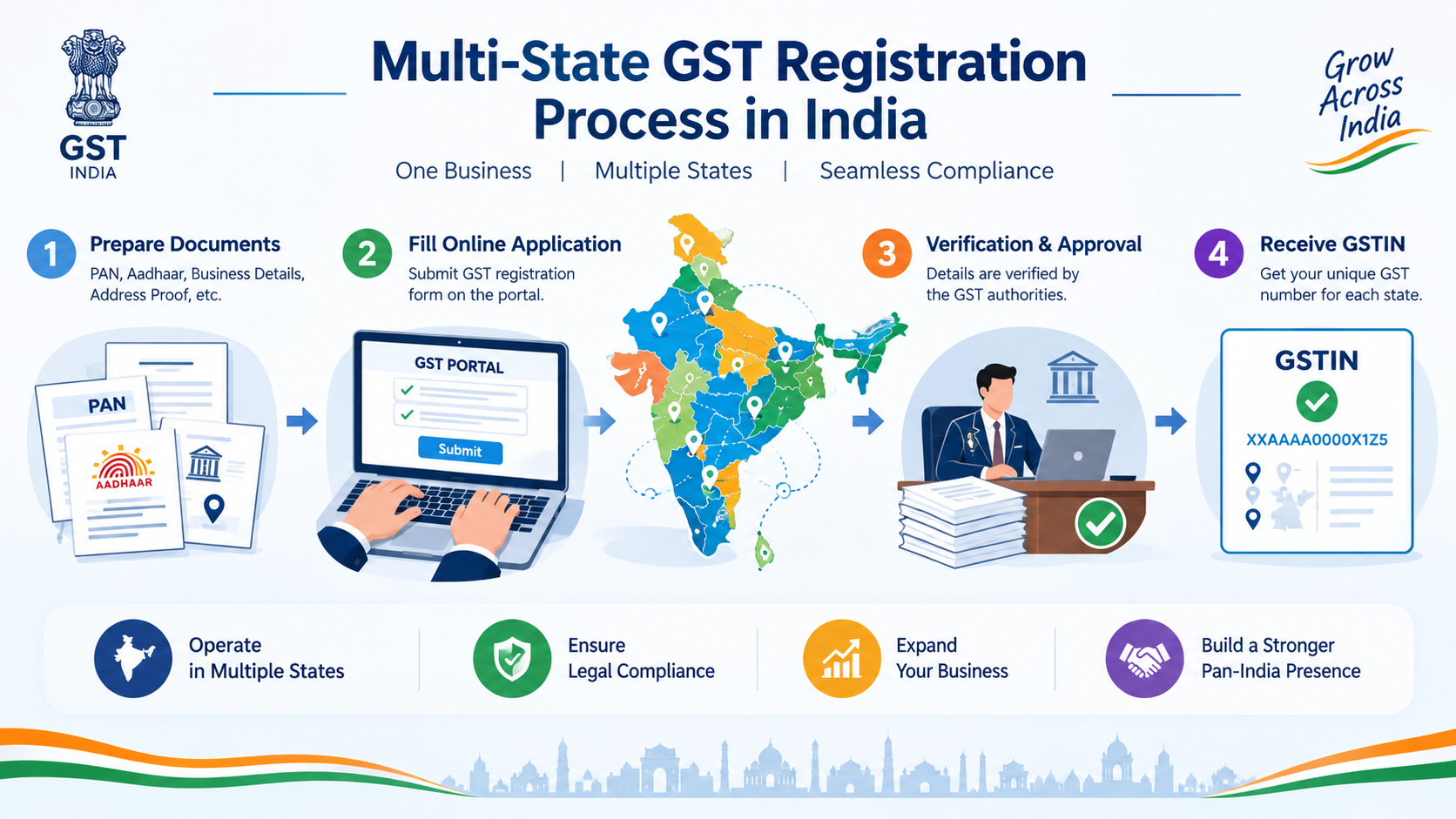
What Is Multi-State GST Registration?
Multi-state GST registration refers to obtaining separate GST registrations for a business in more than one Indian state or union territory, where registration is required under the applicable GST provisions. Each GST registration is linked to the same PAN of the legal entity but has its own state-specific GST Identification Number (GSTIN).
For example, a business with a qualifying place of business in Bihar and another in Uttar Pradesh may need a GST registration in each state. The exact requirement depends on the facts of the business and the law.
When May a Business Need GST Registration in Multiple States?
A separate state registration may be required or relevant in situations such as:
- The business has a place of business in another state and is liable to register there.
- The business operates branches, offices, shops, or warehouses in different states.
- An e-commerce seller stores or fulfils inventory from a location in another state.
- The business expands its operations and establishes a new place of business outside its registered state.
A warehouse or fulfilment arrangement should be reviewed on its actual facts. Do not assume that every third-party logistics arrangement creates the same registration obligation.
Step-by-Step Multi-State GST Registration Process
-
Identify the states where registration may be required
List the states in which the business operates or maintains relevant business locations. Review the nature of each location and the applicable registration rules before applying.
-
Prepare the required documents
Collect the PAN, business constitution documents, identity and authorisation details, and proof of the business address for each state where an application is needed.
-
Open the official GST portal
Visit www.gst.gov.in. Navigate to Services → Registration → New Registration and start the application for the relevant state.
-
Complete Form GST REG-01
Enter the requested taxpayer, PAN, contact, business activity, place of business, and authorised signatory details. Upload the supporting documents requested by the portal.
-
Verify and submit the application
Complete the applicable verification and submit the application. Keep the acknowledgement reference number and application details for tracking and future correspondence.
-
Respond to any clarification request
If the tax officer requests additional information or documents, respond through the prescribed process within the stated deadline. The officer may also conduct verification where permitted by the rules.
-
Receive the GST registration certificate
After approval, download the registration certificate in Form GST REG-06. Complete a separate application for each additional state where registration is required.
Documents Commonly Required
Requirements vary by business constitution and premises. Common documents include:
- PAN of the proprietor or legal entity.
- Aadhaar and identity details, where applicable under the registration process.
- Business constitution proof, such as a partnership deed or certificate of incorporation, where relevant.
- Photographs and details of the proprietor, partners, directors, or authorised signatory, as applicable.
- Proof of the principal place of business in the relevant state.
- Rent or lease agreement, ownership proof, consent letter, or other accepted premises documents, as applicable.
- Authorisation documents for the authorised signatory, where required.
- Valid mobile number and email address for the application process.
What Should Businesses Do After Registration?
Each GSTIN may have separate ongoing compliance obligations. A business should:
- File the applicable GST returns for each registration, including nil returns where required.
- Maintain accurate state-wise sales, purchase, tax, and input tax credit records.
- Issue invoices using the appropriate GSTIN and apply the correct tax treatment.
- Review transfers of goods or services between separately registered establishments, as these may be taxable supplies under GST rules.
- Assess shared expenses and cross-charges between registrations in line with applicable valuation and invoicing rules.
- Track changes in business locations, activities, and registration details and update records when required.
Common Mistakes to Avoid
- Assuming that one GSTIN automatically covers every state where the business has a place of business.
- Applying for registrations in every customer state merely because interstate sales take place.
- Using incorrect or inconsistent premises documents.
- Ignoring notices or missing response deadlines during application processing.
- Assuming that all registrations under one PAN can be managed as if they were a single GSTIN for every compliance purpose.
How Long Does the Process Take?
Processing time can vary depending on application completeness, verification, and whether the tax officer requests clarification or physical verification. There is no single guaranteed approval time for every application. Check the latest portal status and applicable GST rules for your case.
Official Portal and Legal Reference
Start or track an application through the official GST Portal. The registration framework is primarily governed by Section 25 of the Central Goods and Services Tax Act, 2017, and the applicable GST Rules. Review current official provisions or consult a qualified GST professional for advice on a specific business structure.